The report provides a techno-commercial road-map for setting up a cassava
starch processing plant. The study ranges from a macro overview of the
market to micro details of the industry performance, processing &
manufacturing requirements, project cost, ...
The report provides a techno-commercial road-map for setting up a
cassava starch processing plant. The study ranges from a macro overview
of the market to micro details of the industry performance, processing &
manufacturing requirements, project cost, project funding, project
economics, expected returns on investment, profit margins, etc.
This report is a must-read for entrepreneurs, investors, researchers,
consultants, business strategists, and all those who are planning to
foray into the cassava starch industry in any manner.
Key Questions Answered in This Report?
What are the key success and risk factors in the cassava starch
industry?
How has the cassava starch market performed so far and how will it
perform in the coming years?
What is the structure of the cassava starch industry and who are the
key players?
What are the various unit operations involved in a cassava starch
plant?
What is the total size of land required for setting up a cassava
starch plant?
What are the machinery requirements for setting up a cassava starch
plant?
What are the raw material requirements for setting up a cassava starch
plant?
What are the utility requirements for setting up a cassava starch
plant?
What are the manpower requirements for setting up a cassava starch
plant?
What are the infrastructure costs for setting up a cassava starch
plant?
What are the capital costs for setting up a cassava starch plant?
What are the operating costs for setting up a cassava starch plant?
What should be the pricing mechanism of various cassava starch
products?
What will be the income and expenditures for a cassava starch plant?
What is the time required to break-even?
Key Topics Covered:
1 Research Methodology
2 Executive Summary
3 Introduction to the Cassava Starch Industry
4 Cassava Starch Industry Analysis
5 Processing and Manufacturing of Cassava Starch
6 Project Details, Requirements and Costs Involved
7 Cassava Starch Manufacturing Plant: Loans and Financial Assistance
8 Cassava Starch Manufacturing Plant: Project Economics
For more information visit http://www.researchandmarkets.com/research/jvhh5m/cassava_starch
Contacts
Research and Markets Laura Wood, Senior Manager press@researchandmarkets.com For
E.S.T. Office Hours Call 1-917-300-0470 For U.S./CAN Toll Free Call
1-800-526-8630 For GMT Office Hours Call +353-1-416-8900 U.S.
Fax: 646-607-1907 Fax (outside U.S.): +353-1-481-1716 Sector: Food
Ingredients
Cassava
from more than 100 acres of farmlands is lost annually at Mafi Adiekpe
in the Central Tongu District of the Volta Region as a result of the
absence of modern processing facilities.
If you grew up outside the African and South American continents you can be forgiven for thinking cassava is the latest variation of salsa music or perhaps the funky new energy beverage trendy hipsters are drinking these days.
The conference, 'The Second Cassava World-Africa Summit', held on the theme, “Roadmap to Increase Cassava
Production and Investments of higher value-added products”, was
organised by the Centre for Management Technology based in Thailand.
“Some of this project's components include extracting are ethanol from cassava
peels by local farmers and sell it to Ethanol Company Limited (ETHCO)
for production of fuel ethanol which is blended with petrol to run motor
vehicles.
Cassava
is a potential industrial crop, which could reduce imports, increase
exports, create employment and increase smallholder farmers' incomes
along the value chain.
Cassava,
globally considered as a "drought-tolerant" agricultural crop, is said
to be a relief from the increasing crop damages in the region that
already reached some P248.2 million as of December 11, 2015.
The conference, 'The Second Cassava World-Africa Summit', held on the theme, “Roadmap to Increase Cassava
Production and Investments of higher value-added products”, was
organised by the Centre for Management Technology based in Thailand.
Findings from the study which was recently presented in a paper titled, 'The capacity of extension staff in managing weeds in cassava systems in Nigeria' in Nanning, China, during the World Congress on Root and Tuber Crops' revealed that unless ...
Cassava
growers in Thailand, who are currently suffering from falling demand
from China, the key export market, may benefit from rising demand from
the fuel ethanol sector.
Captain
Buth Noeun, the Deputy Chief of Snuo district police, said on Saturday
night about 7 pm three robbers armed with an AK-47 rifle and a pistol
arrived at the cassava shop in Pi Thnou Commune, Snual District, and threatened 55-year-old shop owner ...
He urged government to make the approved enhancers available to bakers to enable them to use cassava flour in baking. He said: “About the cassava flour, I am fully aware of the cassava flour project and I am a member of the oversight committee on ...
We'll
focus instead on the pea shoots and flowering garlic, the bok choy
varieties and guava, the Jamaican ginger beer and Mexican lager, the
Dominican cassava bread and oodles of noodles. These visits yield a wildly diverse haul of groceries and ...
The Virus Resistant Cassava for Africa project aims to develop improved cassava varieties resistant to the cassava brown streak and cassava mosaic diseases, thereby enabling families to produce enough for their own use and surplus that could be sold ...
Brasília,
07, 07 - O Planalto comemorou a decisão do presidente do Tribunal
Regional Federal da 1ª Região, desembargador Cândido Ribeiro, que
derrubou a liminar da juíza Solange Vasconcelos, da primeira instância
do Distrito Federal, que suspendeu, ...
Cassava
Enterprises (Gibraltar) Limited is licensed and regulated to offer
online gaming services under the laws of Gibraltar (Remote Gaming
License Numbers 022 and 039) and makes no representation as to legality
of such services in other jurisdictions.
Lựa chọn và sắp đặt các tin bài trên trang này được xác định một cách tự động bởi một chương trình máy tính.
Third Scientific Conference of the Global Cassava Partnership for
the 21st Century & 17th Symposium of the International Society for
Tropical Root Crops
Welcome to the First World Congress on Root and Tuber
Crops – WCRTC – resulting from the merger of the 3rd Scientific
Conference of the Global Cassava Partnership for the 21st Century
(GCP21) & the 17th Symposium of the International Society for
Tropical Root Crops (ISTRC)
WCRTC is primarily for scientists working on
cassava, sweet-potato, yam, potato, taro and other aroids in tropical
countries around the world. But it is also a congress for developers,
donors and for the private sector, to better use root and tuber crops
for their business. It is of crucial importance that these two worlds
come together to better understand each other to better design future
crops for optimized products!
Root Crops Around the World
Root and tuber crops (RTCs), including cassava, sweet potato, yams,
potato, cocoyams and other root crops are important to the agriculture
and food security of more than 100 countries and overall are a component
of the diet for 2.2 billion people as well as contributing to animals
feeds and industry. The annual world production of root and tuber crops
is about 765 million tones (MT) consisting of potatoes (333mt), cassava
(237mt), sweet potatoes (130mt), yams (53mt), and taro and other aroids
(12mt). The global consumption of tropical root and tuber crops is
about 365kg/capita/year.
News dates confirmed for the World Congress on Root and Tuber Crops
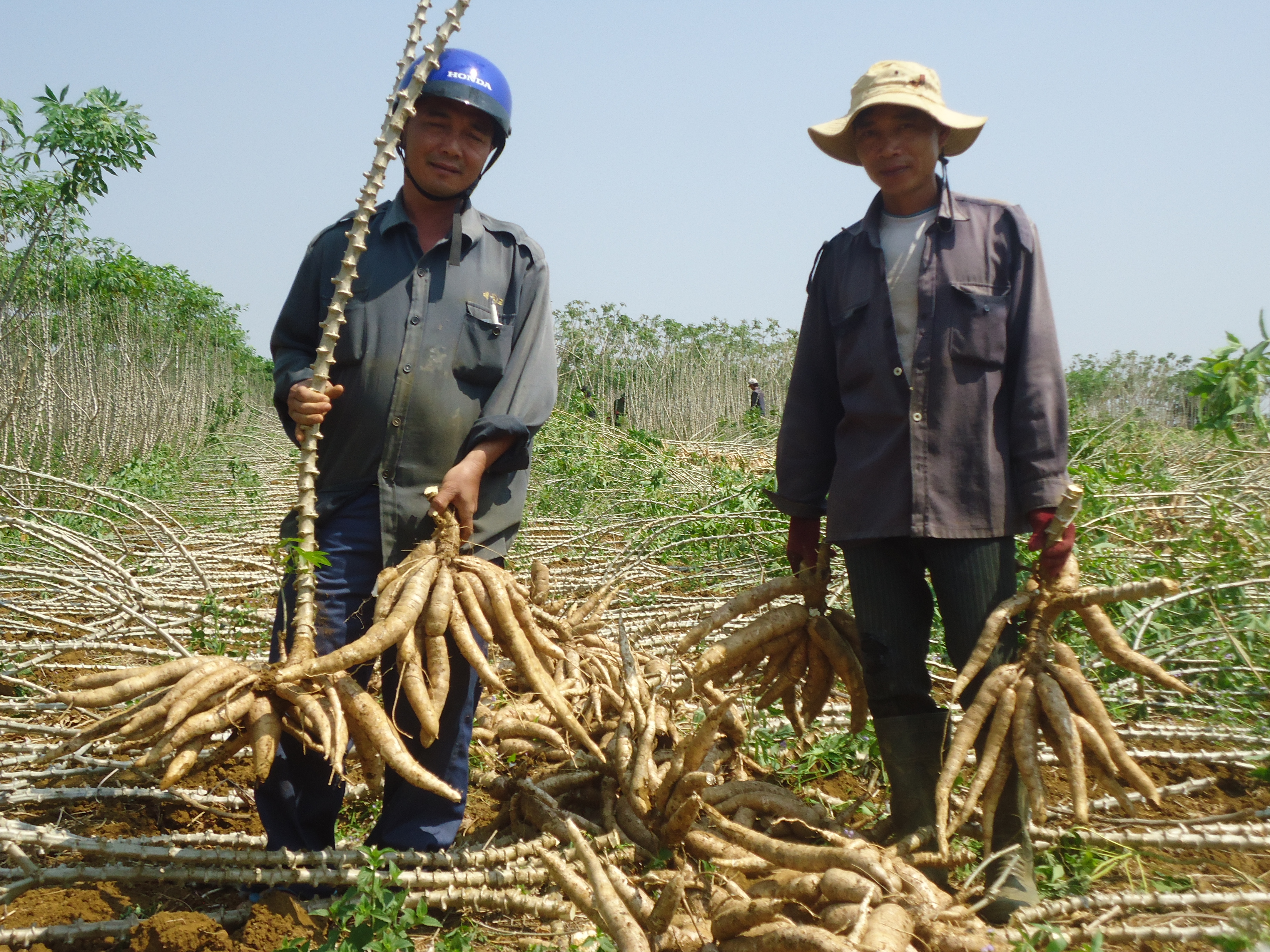
During the past 20 years cassava has become the third most important
export crop in Vietnam.In that short period cassava (Manihot esculentaCrantz) has been converted from a neglected food crop to an important
industrial crop. Thanks to its wide adaptability, cassava can be grown in almost
all ecological regions in Vietnam, even on poor sloping land, thus contributing
significantly to the income of poor farmers.For the last decades cassava production has changed dramatically: between
1975 and 2000, cassava yields in the country ranged from 6 to 8 t/ha, and the
crop was grown mainly for human food and animal feeding. This situation changed markedly with the
introduction by CIAT scientists in 1988 of high-yielding breeding lines and new
varieties from Thailand. The area under cassava increased from 237,600 ha
in 2000 to 560,000 ha in 2014, while yields increased from 8.4 t/ha to 18.3 t/ha.The export value of cassava is now about
1.3-1.5 billion US$/year, making this crop the third most important among
export crops, after only rice and coffee.
Cassava Conservation and
Sustainable Developmentin Vietnam has
been very successful, as indicated by the results of trials and demonstrations
conducted in Tay Ninh, Dak Lak, Phu Yen and Dong Nai provinces, where farmers using
the improved varieties and practices boosted cassava yields from 8.5 t/ha to 36
t/ha − a more than four-fold increase. The Vietnam National Cassava Program
(VNCP) has introduced various methodologies, named “6M” and “10T” (after the
Vietnamese titles all starting with M or T, respectively), as well as Farmer Participatory
Research (FPR). These are collaborative experiences that helped to bring
advanced technologies into production for millions of poor farmers. This
included the selection of high-yielding varieties and the testing and selection
by farmers of locally appropriate technologies.
Cassava
in Vietnam: Trends, Challenges and Direction. Cassava is now considered to be the most
suitable crop for biofuel production in Vietnam, because of its wide availability
and low cost of production, as compared to other potential biofuel crops like
maize or sugarcane. Cassava in Vietnam has greatpotential,but also big challenges. To make cassava production profitable and more sustainable
there is a need for varietal improvement in disease resistance and starch
content, as well as better cultivation techniques.Modern methods of biotechnology for plant
improvement, like genetic engineering, marker assisted selection and others
should be incorporated in cassava breeding.A Joint laboratory between CIAT-RIKEN (Japan) and the Agricultural Genetics
Institute (AGI-Vietnam) for Cassava Molecular Breeding has been established in
AGI as an open platform for cassava research and breeding in Vietnam and the region.
Hoang Kim [1], Nguyen
Thi Truc Mai [2],
Nguyen Bach Mai [3]
and Reinhardt Howeler [4]
ABSTRACT
The project entitled “Vietnam
Cassava Conservation and Sustainable Development” has been very successful, as
indicated by the results of trials and demonstrations conducted in Tay Ninh, Dak
Lak, Phu Yen and Dong Nai provinces, where farmers using the improved
technologies and practices boosted cassava yields from 8.5 t/ha to 36 t/ha - a
more than four fold increase.
During the period from
1975 to 2015 cassava has become the third most important food crop in Vietnam,
after rice and maize. In 2013 the cassava area in Vietnam reached 544,300 ha,
with a production of 9.74 million tonnes, and an average yield of 17.9 t/ha.
Within Asia, Vietnam is now the third largest cassava producer, after Thailand
and Indonesia. Between 1975 and 2000, cassava yields in the country ranged from
6 to 8 t/ha, and the crop was grown mainly for human food and animal feeding. This changed markedly with the introduction by CIAT
in 1988 of some high-yielding breeding lines and varieties from Thailand. Two
varieties, Rayong 60 and KU 50, were selected for release in 1993 and 1995 and
were named KM60 and KM94, respectively. During the 1990s and the first decade
of the 21st Century, Vietnam produced several new cassava varieties,
initially mainly selections from sexual seed from Thailand and CIAT, such as
KM95-3, SM937-26, KM98-1, KM98-7, but our breeders also made crosses that
resulted in the release of the latest new varieties: KM140, KM98-5, KM419 and
others. The breeding and adoption of new
varieties as well as the development and adoption of more sustainable
production practices resulted in a complete transformation of cassava, from a
poor man’s food crop to a highly profitable industrial crop.More
recently, new advances in cassava
cultivation techniques have focused on key demonstration sites in the provinces
of Tay Ninh, Dak Lak and Phu Yen using mainly KM419 as a very promising short-duration
cassava variety with a fresh root yield of about 35-55 t/ha (28% higher than
KM94) and a starch content of about 28-31%. This and other new varieties,
together with new advances in cassava cultivation techniques, have yielded
spectacular results in trials organized in those three provinces.
The
Vietnam National Cassava Program (VNCP) has introduced various methodologies,
named “6M” and “10T”, as well as Farmer Participatory Research (FPR), as
collaborative experiences that helped to bring advanced technologies into
production for millions of poor farmers. This included the selection ofhigh-yieldingvarietiesand the testing and selection by farmers of
locally appropriatetechnologies.
Cassava in Vietnam has greatpotentialbut also faces big challenges.At the national level, cassava has become one of the
main export crops, which has provided for millions of smallholders an
opportunity to increase their yields and improve their standard of living.
After
extensive consumer research, Global Gardens Group came up with Veggemo ,
a plant-based milk-like beverage made out of pea protein, tapioca from cassava roots, and the starch of potatoes. It launched in October 2015 and is sold in major Canadian ...
According to the Commissioner, the state is targeting an average of one million tonnes of cassava annually, expected to provide about,100,000 direct and indirect jobs.
Dr
Adetunji Oredipe, Senior Agricultural Economist with the World Bank on
Tuesday said the bank would establish equipment hiring enterprise
centres for cassava farmers in Kogi to encourage mechanisation. Oredipe disclosed this in Lokoja when he led a ...
Cambodian cassava
farmers are facing dropping prices in the agro commodity this season,
as the lack of a domestic market and dependence on exports, which faces
competition from neighbouring countries, has led them to call for
government intervention.
The
Ikole Local Government Council in Ekiti state, on Monday, said it has
concluded plans to cultivate about 20,000 hectares of maize and cassava during the forthcoming farming season. The council's Vice-Chairman, Alhaji Azeez Olasoji, identified ...
CEBU CITY—A six-year-old boy died while his two siblings were confined in a hospital on Wednesday morning after eating boiled cassava in Barangay Balaygtiki, Dumanjug town, 74.3 kilometers southwest of Cebu City. Noven Pasuquin Monteza died in ...
A health official issued the advice as cassava
that is improperly cooked may have caused food poisoning which resulted
in the death of a six-year-old boy in Dumanjug town, southern Cebu.
Peel the cassava
completely, cut into thirds, and then cut each third in half
vertically. Remove the indigestible core, and cut into bite-sized
portions.
Olaoluwa,
who was represented by the Group Head, Agro Processing Unit of BoI,
Mrs. Ruth Kadafa said farming is a serious business and cassava is a profitable trade but there is a significant need for many farmers to improve on their skills and ...
He disclosed this during a press briefing in Ibadan, saying the yellow root cassava
which is among the newly released Vitamin A fortified varieties could
reduce the cost of production since there would be no need to add palm
oil to give 'garri' a ...
A dramatic drop in the price of cassava
this year has forced farmers and middlemen to drop out of the business
and seek aid from the government and stakeholders, farmers and brokers
said.
1625793253editor_Ogbonnaya_Onu
The Minister of Science Technology, Dr. Ogbonnaya Onu, has averred that
over three million jobs stand to be created if only 20 per cent of cassava is used to replace wheat in making bread in the country. This was as he ...
A SIX-year-old boy died yesterday dawn while two of his siblings landed in the hospital after reportedly eating cassava in the mountain barangay of Balaygtiki, Dumanjug.
The
Women in Agricultural Development (WIAD) Unit of the Western Regional
office of the Ministry of Food and Agriculture (MoFA) has embarked on a
series of training for a number of people engaged in cassava processing in the Western Region. About 150 ...
Olaoluwa,
who was represented by the Group Head, Agro Processing Unit of BOI,
Mrs. Kadafa Lolo Ruth, said farming was a serious business and cassava a profitable trade, noting however that there is a significant need for many farmers to improve on ...
The price of cassava
for export has been depressed by news of China reducing its Thai
imports, following the Chinese government policy to subsidize maize.
SAN
JOSE, Costa Rica (CMC) - Technical officers from five Caribbean
countries have ended a week-long workshop aimed at learning about new
ways of adding value to cassava production and modern technologies for processing the vegetable, the ...
SAN
Jose, Costa Rica (CMC) - Technical officers from five Caribbean
countries have ended a weeklong workshop aimed at learning about new
ways of adding value to cassava production and modern technologies for processing the vegetable, the ...
Minister of Food and Agriculture, Mr Fifi Kwetey at the inauguration of the Ghana Industrial Cassava
Stakeholders Platform (GICSP) in Accra said the government's agenda to
transform the economy through agriculture, would focus on the cassava value chain.
An International agro-based organisation, HarvestPlus Nigeria, on Saturday said it distributed vitamin A cassava stems to no fewer than 700, 000 farmers in 25 states in the country in 2015.
The Centre for Scientific and Industrial Research (CSIR) had released three improved cassava varieties to the Jomoro District of the Ministry of Food and Agriculture (MOFA) in Western Region to help increase Cassava production for local consumption and ...
This novel approach to global cassava
genome research is designed to unravel the plant's complex evolutionary
history and genetic diversity with the goal of increasing the
production and nutritional value of a primary food source in Africa,
Latin ...
Technical officers from six Caribbean countries traveled to Costa Rica to learn about new ways of adding value to cassava
production and modern technologies for processing the vegetable, in
order to boost the industry, promote the diversification of ...
An International agro-based organisation, HarvestPlus Nigeria, on Saturday said it distributed vitamin A cassava stems to no fewer than 700, 000 farmers in 25 states in the country in 2015.
Co-owner Vung Nguyen told Savor that Cassava
( which opened in August ) came about because "most of the bubble-tea
places are on Argyle [Street] or in Chinatown—and I live two blocks from
here.
crime (2) A Malawian man identified as Siska Nyirenda has been found dead inside a cassava plantation in Nkhatabay, police in the district have confirmed.
The Federal Government has been urged to double its efforts in boosting cassava production. Participants made the call at the Agra Innovate exhibition in Victoria Island, Lagos.
Minister of Food and Agriculture, Mr Fifi Kwetey at the inauguration of the Ghana Industrial Cassava
Stakeholders Platform (GICSP) in Accra said the government's agenda to
transform the economy through agriculture, would focus on the cassava value chain.
When
I undertook a sociological survey, at the age of 23 years, among the
Veddas of Wellassa-Bintenne in Ceylon in 1950/51, I came to understand
the role of cassava (manioc) in the lives of the poor. Although the Veddas were mainly hunters/gatherers at ...
He again alluded the possibility of shortage of cassava in the country for the fact that as at now a sack of cassava
has reached GH¢140 in Kumasi and its environs and in Accra; thus this
kind of incident has not happened before in the country, posing a ...
Aug 28, 2008 ... The disadvantages to cassava and sweet potato are higher start-up costs,
particularly because of increased labor at planting and harvesting ...
Cassava varieties are often categorized as either "sweet" or "bitter", signifying the
... rind, about 1 mm thick, rough and brown on the outside, just like a potato.
Apr 21, 2015 ...Sweet potatoes from all over the world naturally contain genes from the
bacterium Agrobacterium, researchers report. Sweet potato is one of ...
Oct 9, 2015 ... Plant scientists engineered the cassava plant to produce higher levels of vitamin
B6 in its ... Sweet Potato Leaves a Good Source of Vitamins.
Nov 2, 2007 ...Sweetpotatoes are classified as "storage roots" and belong to the ... and in
Uganda, where a virus ravaged cassava crops in the 1990s, the ...
Nov 9, 2012 ... ... fine sand and red river sediment; 85.2 percent ate such raw starches as raw
cassava, raw sweet potato, uncooked rice and another local wild ...
Jan 14, 2015 ... A study designed to determine the ascorbic acid, thiamin, riboflavin, and vitamin
B6 content in foliar tissues of sweet potato confirmed that ...
Jun 21, 2011 ... Agricultural scientists in the U.S. have developed a new variety of not-so-sweetpotato, called Liberty. Known as a boniato, or tropical sweet ...
Aug 12, 2015 ... In South Africa, sweet potatoes are a traditional crop for rural families.
Researchers undertook a project to develop a local variety that has good ...
Mar 6, 2007 ... ... to substitute extracts of potatoes, celery, eggplant, carrot, cassava, ...
Electrifying Success in Raising Antioxidant Levels in Sweet Potatoes.
Oct 12, 2015 ... ... developing countries to identify system strengths and weaknesses for
managing diseases of potato, sweet potato, cassava, banana and yam ...
Feb 15, 2014 ... In South America, where potatoes originated, more than 5000 ... in the U.S. have
developed a new variety of not-so-sweet potato, called Liberty.
Jul 10, 2011 ... By honing in on the mysterious potato genome and its tuber -- its edible ... Sweetpotato is one of the most important food crops for human ...
Sep 9, 2010 ... 12, 2015 — In South Africa, sweet potatoes are a traditional crop for rural families
. ... Using Cassava to Address Vitamin A Deficiency. Oct. 4 ...
Mar 3, 2014 ... ... considerable regional importance -- including cereals like sorghum, millets and
rye, as well as root crops such as sweet potato, cassava and ...
Jul 7, 1997 ... (Most root crops in Third World countries, such as cassava and taro, contain ...
gene in other plants, such as turnips, radishes, and sweet potato.
May 1, 2012 ... ... gives color to foods such as carrots, sweet potatoes and certain greens. ... rice
in Asia, golden maize in South America and cassava in Africa.
Oct 4, 2005 ... Humans have cultivated potatoes for millennia, but there has been great ... and
related plants · Recent single-origin hypothesis · Cassava (Yuca) · Citrus .... have
developed a new variety of not-so-sweet potato, called Liberty.
Apr 24, 2013 ... The result was three clones of the purple-fleshed potato and one with a ... 12,
2015 — In South Africa, sweet potatoes are a traditional crop for ...
May 6, 2010 ... ARS physiologist Jeffrey Suttle is evaluating how well new potato .... U.S. have
developed a new variety of not-so-sweet potato, called Liberty.